


Added to your cart
There are no more items in your cart
How to choose a mattress topper?
How to choose a mattress topper?
Are you still struggling to sleep comfortably on an unsuitable sofa bed? Is your old mattress too firm? Do you wish you could improve the quality of your sleep? A mattress topper can make your sleep surface more comfortable without replacing your sofa bed or existing mattress. All you need is a comfortable, practical and high-quality mattress topper. But how do you choose the right one?
With such a wide range of mattress toppers available today, finding the right one can be challenging. Options range from thinner, more affordable models to thicker toppers offering a greater level of comfort. Your choice will largely depend on your individual needs, but it is worth understanding a few key factors before making a decision.
Mattress Topper Materials
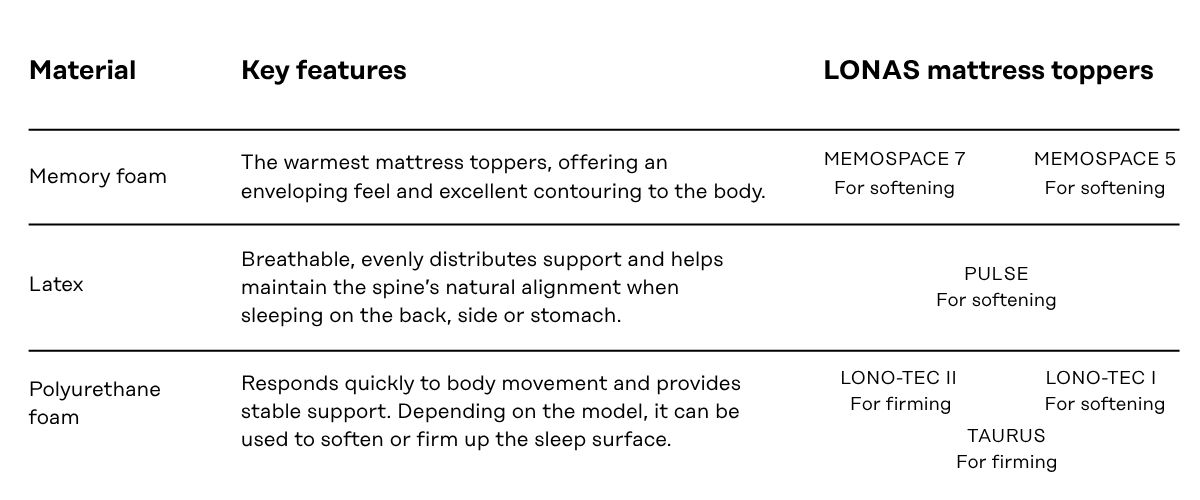
Before choosing a mattress topper, it is important to understand how different materials affect comfort. The material determines how the topper adapts to the body, the type of support it provides and how effectively it dissipates heat during sleep. Some materials offer a more enveloping, softer feel, while others provide more responsive or firmer support.
Viscoelastic Foam
Thanks to their unique composition, viscoelastic foam mattress toppers are especially well suited to those who prefer a warmer sleeping environment. The foam responds to body heat by softening, allowing it to conform precisely to the body’s contours and retain a pleasant warmth throughout the night. These properties make the sleep surface particularly suitable for people experiencing joint pain or numbness in certain parts of the body.
LONAS viscoelastic mattress toppers feature specially formulated Memospace® foam, developed using NASA space technology. It is resilient, durable and breathable. By adapting to the body’s contours, the material helps the muscles relax and creates a feeling of lightness.
This type of mattress topper is also one of the most suitable options for people with allergies, as the viscoelastic foam used by LONAS creates an unfavourable environment for dust mites. All our viscoelastic mattress toppers feature an antibacterial cover with Lonofibre®, which is easy to wash and care for.
Latex
Latex offers point elasticity: it compresses only where the body exerts the most pressure. This allows it to adapt precisely to the body’s contours, distribute support evenly and help maintain the spine’s natural alignment. Its responsive structure ensures comfort when sleeping on the back, side or stomach.
The open-cell structure of latex allows air to circulate freely, helps prevent moisture build-up and maintains a pleasant sleeping microclimate. Thanks to its excellent thermoregulating properties, latex helps prevent overheating during warmer months while providing a cosy feel when the temperature drops. It adapts exceptionally well to the body, so we would not be surprised if your first thought upon lying down were, “This is so comfortable.”
Polyurethane Foam
These mattress toppers are highly resilient, distribute body weight evenly and adapt to the shape of the body. Depending on the model, polyurethane foam can either soften the sleep surface or make it firmer.
LONAS polyurethane foam mattress toppers are highly hygienic, effectively wick away moisture and help prevent dust mites from accumulating, making them particularly suitable for people with allergies.
These mattress toppers are an excellent choice for those seeking a responsive solution that distributes body weight evenly and adjusts the feel of their existing sleep surface.
Mattress Topper Cover
A synthetic mattress topper cover should not be considered an inferior choice. LONAS mattress topper covers are made from 100% polyester and have antibacterial properties. The fabric also creates an unfavourable environment for dust mites.
The cover can be easily removed when needed by unfastening the zip along all four sides, making regular cleaning simple. The three-layer cover featuring Lonofibre® technology can be washed at temperatures of up to 60°C, helping to eliminate bacteria and remove stains effectively.
However, when choosing a mattress topper, it is important to consider not only its material but also its firmness and thickness, as well as the properties of your existing sleep surface.
Mattress Topper Thickness
The thickness of a mattress topper determines how noticeably it will change the feel of your existing mattress or sofa bed. A thinner topper provides a subtle change in comfort, while a thicker one can make a greater difference to the softness, firmness and level of support. When choosing a topper, it is important to consider the desired result and the condition of the existing sleep surface. Mattress toppers are generally divided into three thickness categories:
3 cm Mattress Topper. A 3 cm mattress topper is suitable for slightly adjusting the feel of the sleep surface, smoothing out minor unevenness or reducing the gap between two mattresses or sections of a sofa bed. Thinner toppers are also commonly used for hygiene purposes and to protect the sleep surface. Due to its modest thickness, a 3 cm topper alters the properties of the existing surface the least.
5 cm Mattress Topper. A 5 cm mattress topper provides a more noticeable change in comfort and support. Depending on the material, it can soften a surface that is too firm or add firmness to one that is too soft. It is a versatile choice for everyday sleep.
7 cm Mattress Topper. A 7 cm mattress topper is the thickest option. It is particularly useful for covering an old mattress or sofa bed that has lost its shape and no longer provides adequate support. Its generous thickness provides the necessary support for the body and helps smooth out unevenness in the existing sleep surface. A 7 cm topper is the best choice when you want to significantly improve your sleeping conditions without replacing your current mattress or sofa bed.

Mattress Topper Firmness
The firmness of a mattress topper is another key factor in ensuring comfort and restful sleep. Although specialists recommend listening to your body when choosing a mattress topper, it is also important to consider your preferred sleeping position: on your stomach, side or back.
If you prefer sleeping on your side, a soft or medium-firm mattress topper is usually the best choice. A topper that is too firm may place excessive pressure on key areas of the body and prevent the spine from maintaining its natural alignment. If you tend to sleep on your back or stomach, choose a firmer mattress topper. A topper that is too soft may not provide sufficient support in these positions, potentially leading to discomfort in the back, shoulders, neck or head.
Conclusion
Comfort is subjective and highly personal. When choosing a mattress topper, it is important to consider as many factors as possible, as every carefully considered detail contributes to achieving the level of comfort you are seeking.
In addition to the topper’s material, firmness and thickness, consider your individual needs, preferred level of comfort, the size and condition of your existing mattress or sofa bed, your budget and any other personal priorities. Only you know what feels right for your body. The right sleep surface can help you wake up feeling refreshed and well rested.
There is no need to continue sleeping uncomfortably on an unsuitable sofa bed or an old mattress. Choosing the right mattress topper can make a noticeable difference to your comfort and sleep quality. Better sleep can help you feel more energetic, focused and ready for the day ahead.
Sometimes, one carefully chosen change is all it takes to improve your everyday well-being.
